
BY ANASTASIA KURNIADI, ASSOCIATE
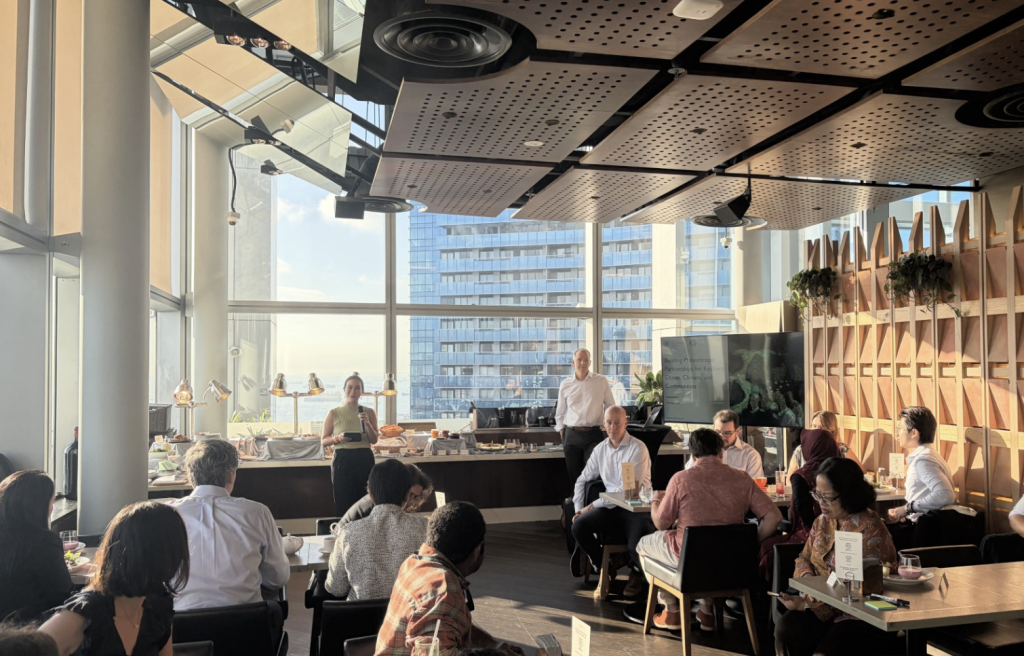
“Building Philanthropic Partnerships for Resilient Ocean, Climate, and Communities” funders breakfast event, 19 May 2026
Just as the morning rush began, a group of funders working across ocean, climate, communities, and forests in Southeast Asia gathered. Co-hosted by Asia Philanthropy Circle (APC) and the Indonesia Marine Funders Collaboration (IMFC) on the sidelines of the 6th Philanthropy Asia Summit (PAS), the breakfast was designed with a simple but powerful intention: to bring funders across these intersecting fields together and ask, “How does your work relate to others in this room?”
There was something special about watching old friends reconnect after months of working from different corners of the world, while new friendships formed over eggs and coffee. With the bay stretched out behind us, it felt like a reunion amid the excitement of PAS.
The session was intentionally left open to wherever the conversation might lead, but John Claussen and Kathlyn Tan grounded the morning in two ideas: nexus and collaboration. The first spoke to the interconnectedness and complexity of the work everyone in the room was pursuing. The second centred the question of what it means to show up as a funder in relation to others across the wider impact ecosystem.
Letting communities and place set the agenda
Communities and natural systems don’t experience climate change, biodiversity loss, ocean degradation, and deforestation as separate problems—they experience them all at once.
Participants echoed that communities should be front and centre in setting agendas, deciding who to work with, and shaping the projects and approaches to support. Doing so requires understanding local contexts and priorities, then allowing that understanding to shape collaboration across issue areas. Trust-based and unrestricted funding emerged as one practical way to support this more relational form of grantmaking, giving communities the flexibility to direct resources where they are most needed. In short, funding in ways that reflect how communities actually live.
North Maluku illustrated this well. A province at the heart of the Coral Triangle, it hosts globally important fisheries, significant terrestrial biodiversity, customary governance traditions, and major nickel deposits. While the environmental impacts of mining are often framed as a terrestrial issue, they cannot be addressed on land alone. Waste discharge and downstream contamination affect marine biodiversity just as profoundly.
Co-beneficial solutions also surfaced, though participants were careful to approach them with nuance rather than enthusiasm alone. Offshore wind installations, for example, have inadvertently created exclusion zones that now function as de facto marine protected areas, a genuine conservation benefit. Yet the environmental costs of building that infrastructure remain real and should not be overlooked.
Ultimately, the discussion reinforced that local context determines whether an intervention truly fits the place it is meant to serve, rather than simply looking good on paper.

What we bring to the table
Each funder recognised that they sit at different roundtables, with different stakeholders. What they bring isn’t just funding, but networks, legitimacy, access, and lived experience. Every funder holds a different combination of these assets, and recognising those differences is where real value begins to emerge.
Seeing the full picture, however, requires a kind of honesty that isn’t always comfortable. Participants spoke candidly about naming power dynamics openly rather than talking around them, and about making a genuine shift towards more decentralised decision-making. That also means working intentionally with actors who hold deep local knowledge, aligning with community priorities, and ensuring communication flows both ways. Holding one another accountable to these values, even when uncomfortable, was recognised as some of the most important work ahead.
The group also explored how to work more meaningfully with intermediaries, who often hold deep local knowledge and networks while enabling impact to scale through trusted partnerships. Participants noted that greater attention should be given to values alignment and intentional capacity-building within countries and regions to keep communities at the centre of decision-making.
Funders building on each other’s strengths
Each donor, regranting partner, and intermediary occupies a different position within the impact ecosystem. Those differences create opportunities for complementarity, but only when engagement is intentional.
Several practical opportunities emerged. Social entrepreneurs were highlighted as critical actors because conservation and climate goals cannot be separated from communities’ livelihoods and basic needs. Participants saw value in engaging across the full capital spectrum—from mission-related investments and venture capital to impact investing, matching the right financial model to the right context and stage of growth. Underpinning this was a call for greater transparency about the risks funders are willing to take, helping to avoid greenwashing.
There was also strong interest in more holistic, rights-based economic models. Emerging large-scale marine financing vehicles that blend commercial and patient capital at landscape scale were highlighted as one promising direction, particularly when paired with business capacity-building and strong governance.
What struck us most by the end of breakfast was how much can emerge when funders working across different issues are simply given space to think together. The appetite to continue the conversation was evident, with Bangkok Climate Action Week and PAS 2027 both raised as natural opportunities to reconvene.
Working intersectionally is rarely the easiest place to begin. We organise funding by sectors because it makes complex problems more manageable and grants easier to measure. But complexity does not disappear simply because our funding structures simplify it—and much can be lost in that gap. This breakfast reminded us that we don’t need to solve the whole system at once to begin closing it. Sometimes it starts with one place, one community, and one honest conversation viewed through a shared lens.